
Stimulus Channels#
Stimulus view summarizes detected trigger channels and event structure used for epoching.
For execution steps, see Tutorial.
Subject-report stimulus view#
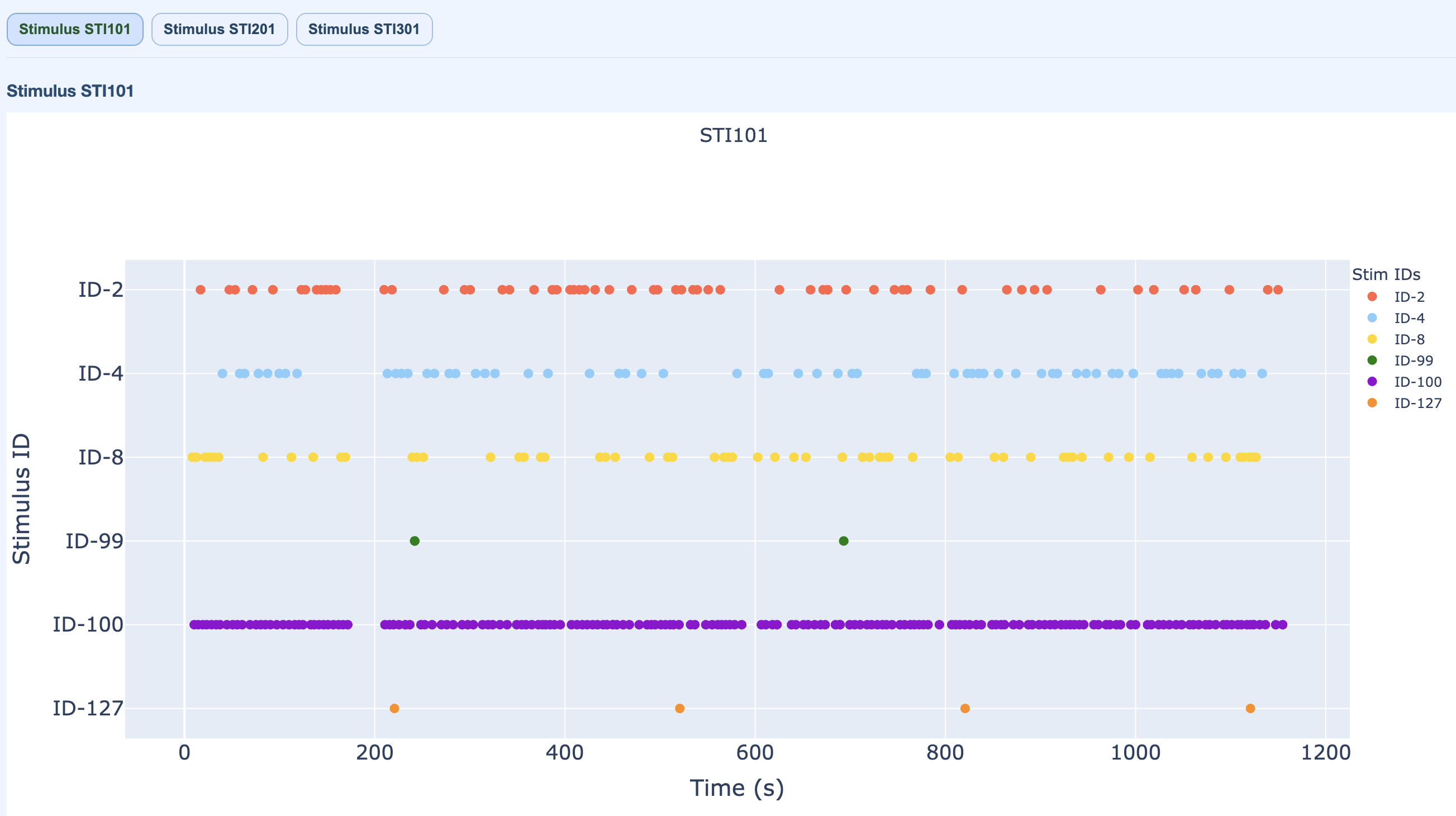
What is shown:
stimulus channel IDs (one channel per row on Y axis),
event IDs/types per channel,
event counts,
epoching context for event-based segmentation.
Why this view is critical#
Event integrity affects all epoch-dependent metrics (for example STD/PtP/ECG/EOG epoch summaries).
Use this panel to verify:
the expected trigger channels are present,
event IDs are plausible,
no obvious trigger sparsity or corruption is present.
QC implications#
missing or malformed trigger structure can force fixed-length epoch fallback,
task/run comparisons are less interpretable when event definitions differ,
trigger anomalies should be documented before downstream QC decisions.
When stimulus channels are unavailable or unreliable, MEGqc falls back to fixed-length epoching (configurable via use_fixed_length_epochs and fixed_epoch_duration in settings). The stimulus view helps identify whether event-based or fixed-length epoching was used.